Skip to content

Industries · Logistics

Custom logistics software development: from warehouse to customer, in one system

We build the logistics software your operation needs: inventory by warehouse, waybills with their status in plain sight, couriers with end-of-day cash reconciliation and partner carriers, all in one custom system built in Bogotá. So nobody has to call to ask where an order is, and the cash collected on the street adds up at the end of the day.

30-minute assessment, free and with no commitment · Monday to Friday, 8:00 a.m.–1:00 p.m. and 2:00–5:00 p.m.

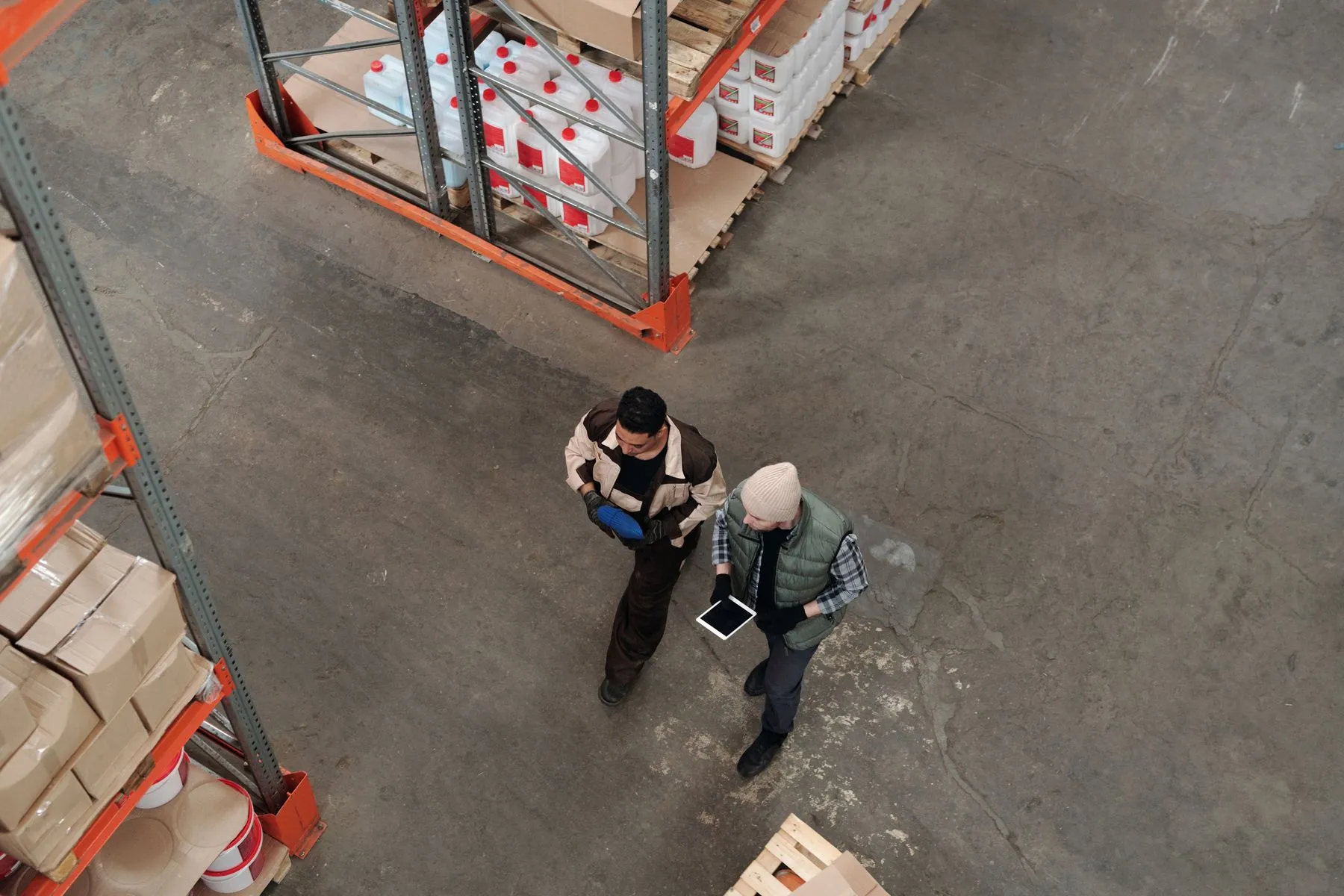
Two workers check inventory on a tablet between the shelves of a distribution center
What we see in the sector

What problems does it solve in a logistics operation?

The same ones repeat from one company to the next, whether it runs its own warehouse, operates a courier service or is a retailer shipping its own orders.

The inventory in the system isn’t the one on the shelf

Receipts are logged late, outgoing stock isn’t deducted and nobody knows which location each product ended up in.

The order status lives in someone’s head

To find out whether a shipment left, is out for delivery or ran into an issue, someone has to call the warehouse, the courier or the carrier.

Cash on delivery doesn’t add up

The courier collects in cash or by bank transfer, hands the money over at the end of the day and the reconciliation is done by hand, if it gets done at all.

Returns and delivery exceptions get lost

A rejected order goes back to the warehouse without anyone logging it, and the inventory is off again.

Every party works in its own tool

Suppliers, warehouse, couriers, carriers and sellers each see a different piece of the same order, and none of them sees the rest.

Growing means hiring more people to type

Every new warehouse or route multiplies the manual work instead of spreading it.

Before you hire

What is custom logistics software, and when is it the right choice?

Custom logistics software is a system built around the way your company already moves goods —how it receives, stores, ships, delivers and collects— instead of forcing you to adapt to an off-the-shelf product. It makes sense when your operation has rules no standard program covers, or when today it runs on spreadsheets, WhatsApp groups and phone calls.

If your operation is the same as any other warehouse, an off-the-shelf WMS or TMS may be enough, and we’ll tell you so. If what makes it different —cash on delivery, partners who deliver for you, suppliers who ship to your warehouse, customers who want to see their order— is exactly what off-the-shelf software doesn’t handle, that’s where custom software development in Bogotá comes in.

The honest question

Off-the-shelf WMS, TMS or custom development?

A WMS organizes what happens inside the warehouse: locations, picking, stock levels. A TMS organizes what happens outside: dispatches, routes, fleet and deliveries. Both exist as licensed, off-the-shelf products, and they are the sensible option if your operation is typical for your sector.

Custom development makes sense when:

  • Your operation spans both —warehouse, delivery and collection— and today you stitch them together by hand.
  • You have parties no product accounts for: suppliers who ship to your warehouse, sellers who aren’t employees, partners who deliver for you.
  • You collect cash on delivery and need to reconcile what each courier collects.
  • You already paid for an off-the-shelf product and your team works around it with spreadsheets.

And there’s a third way that is often the best one: keep the standard tools that already work —your accounting software, your carrier— and build custom only what ties them together. In the assessment we tell you which of the three fits, even if the answer is that you don’t need us.

What we build

What do we build for logistics companies?

Every project comes from your real process, so the list changes from one company to another. These are the modules that come up most often, and we have built all of them before for an operation that is in production today.

01

Inventory by warehouse, with traceability

Receipts, stock levels, outgoing goods and storage location, warehouse by warehouse and supplier by supplier. Every product keeps its history: when it came in, which warehouse it left from and where it went. Order picking before dispatch is included.

02

The waybill as the common thread

Every order has a waybill and a status that everyone checks on the same screen: pending, being prepared, in transit, out for delivery, delivered, exception, return. The statuses are defined with your operation, not imposed on it.

03

Cash on delivery and courier cash reconciliation

Management of your couriers and partner carriers, with their offices and dispatches, and an end-of-day close that separates what was collected by each payment method, is confirmed by the coordinator and leaves the reconciliation ready. It’s the point where, without a system, money gets lost.

04

Exceptions and returns

A dashboard for what didn’t go right: wrong address, customer not home, refusal. Every exception and every return is recorded on the order, in front of whoever has to resolve it.

05

A portal for every party

Suppliers, warehouse and logistics coordinators, couriers, carriers, sellers and management log in to the same system, each with their own menu and seeing only what concerns them. Permissions and an audit trail of every movement are included.

06

Management dashboard

The operation’s indicators on a single screen: orders, sales, warehouses, suppliers and balances. Which ones your management tracks is agreed with you when we map the process.

Integrations

What systems does logistics software integrate with?

Logistics software that doesn’t talk to the rest of your operation is just another spreadsheet. These are the usual integrations in Colombia; which ones yours needs, and whether the third party offers a way to connect, is reviewed in the assessment before we promise anything.

National carriers in Colombia

If you operate in Colombia: waybill generation and status lookups with the carriers you already use. Not all of them offer the same thing: some let you generate the waybill but not quote the shipment, so the scope is confirmed with each one.

  • Servientrega
  • Coordinadora
  • Interrapidísimo
  • Envía
  • TCC

Electronic invoicing

In Colombia, the invoice is issued through your accounting software or your e-invoicing technology provider; the logistics system sends it the order data so nobody types it twice.

  • DIAN (Colombia’s tax authority), through your accounting software or technology provider

Freight transport

If you operate in Colombia: if you move freight by road, the electronic cargo manifest is reported to the RNDC, which has its own web service for integration from the company’s system.

  • RNDC of Colombia’s Ministry of Transport

Online stores

Orders come into the system automatically, without copying them by hand. If you don’t have a store yet, we build an online store with connected inventory and shipping.

  • Shopify
  • WooCommerce

ERP or accounting software

The logistics system handles the operation and the accounting software handles the books, connected through ERP and systems integration.

  • Odoo
  • Siigo
  • World Office
  • Alegra
  • Your accounting software

Your own API

So your suppliers, corporate clients or partners can look up and register orders from their own systems.

  • REST API with credentials
  • Sandbox environment
  • Automatic notifications (webhooks)

We have no commercial partnership with any of these companies: we name them because they are the ones logistics operations use in Colombia. What we have already built in a real project is the API with webhooks, the Shopify connection and the Odoo integration; the rest is confirmed in the assessment.

How we work

How do we run a logistics software project?

  1. 01

    30-minute assessment, free of charge

    A conversation to understand where your operation is losing time and money, and to tell you frankly whether an off-the-shelf product, a custom build or a mix is right for you.

  2. 02

    Process mapping

    We talk to the people who do the work today: the warehouse coordinator, the dispatcher, whoever reconciles the courier’s cash. The right software comes from the real process, not from a form.

  3. 03

    Built in increments

    Throughout the project there are working releases you can test in your browser. We prioritize what hurts most —almost always the order status or the cash collection— so the system starts being useful before it’s complete.

  4. 04

    Data migration

    Your inventory, your customers and your history move to the new system clean and verified with your team before go-live.

  5. 05

    Support and evolution

    Your operation changes —one more warehouse, a new carrier, another payment method— and the system changes with it. The code and the data are yours, with documentation and a formal handover.

Real projects

A real case: Dropanas’ operation on a single platform

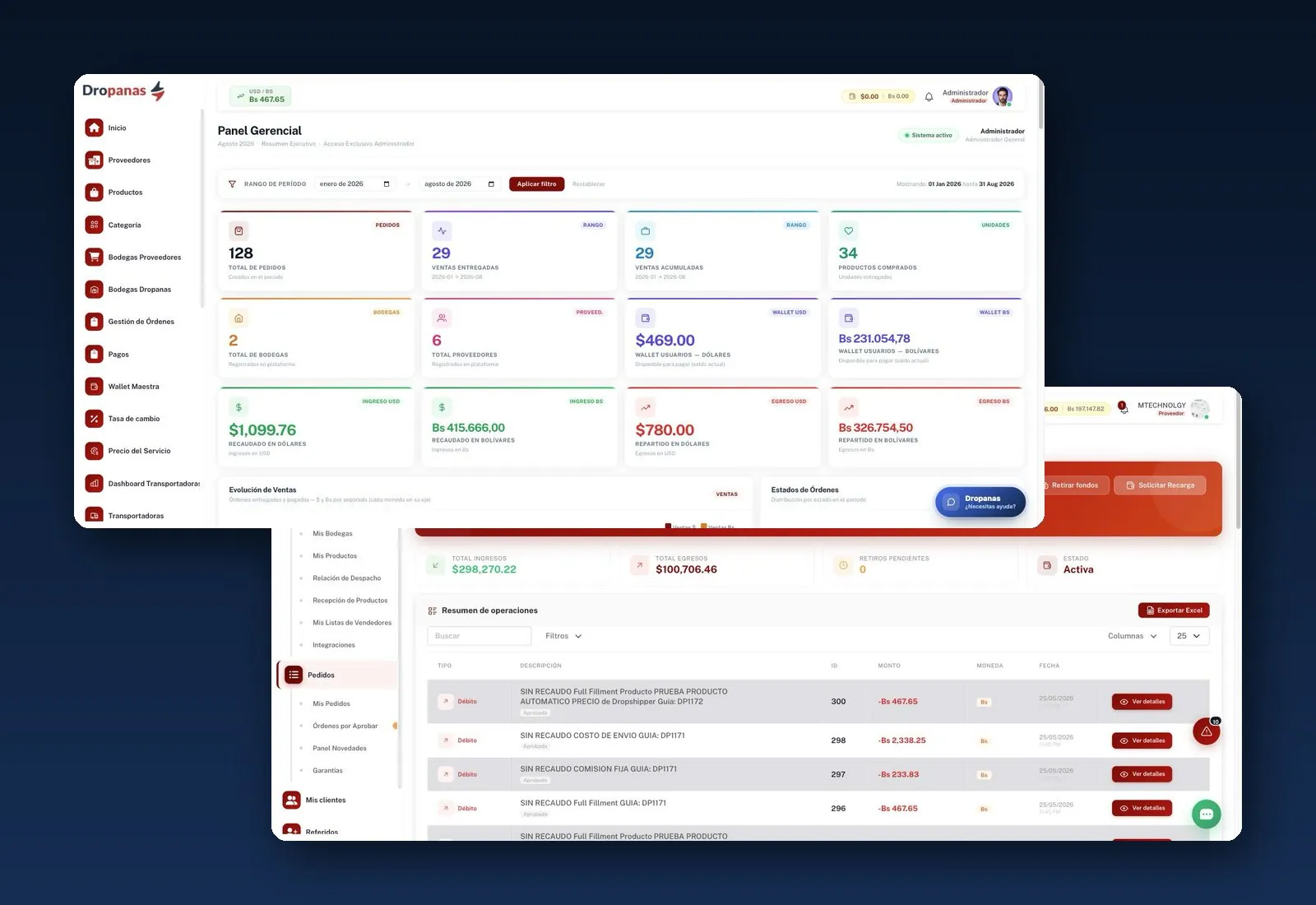
Dropanas connects suppliers, sellers and buyers in Venezuela: the seller sells, the supplier ships to the warehouse and a network of couriers and carriers delivers and collects. We did the full redesign of the platform and built what it was missing to run that entire operation in one system. See the platform we built for Dropanas, screen by screen.

Dropanas

Warehouse, waybills, couriers and suppliers in one system

Inventory by warehouse with storage location and each product’s history; a waybill with nine statuses seen at the same time by the seller, the warehouse, the courier and the partner carrier; the courier’s close, which separates cash in two currencies, mobile payment and Zelle and leaves the reconciliation ready; sixteen user profiles with their own menu; a supplier portal, and a REST API with tokens, a sandbox environment and webhooks, plus a bridge to Shopify for the sellers’ stores.

See the project: Dropanas

The projects belong to our clients and MTechnology built them; each case study says so. See the full portfolio.

Frequently asked questions

Frequently asked questions about custom logistics software

How much does custom logistics software cost?

It depends on how many parties use the system (warehouse, couriers, suppliers, customers), how many integrations you need —carriers, accounting software, online store— and how much has to be migrated. The investment is put in writing in the proposal, after a free 30-minute assessment where we tell you where to start.

How do you reconcile what each courier collects on delivery?

With a cash reconciliation per courier inside the same system: when the route ends, what was collected is split by payment method —cash, bank transfer or whatever you use—, the coordinator confirms it and the reconciliation is ready against the delivered orders. That’s what we built for Dropanas.

Can you answer “where’s my order?” on WhatsApp without someone having to look it up?

Yes, when the shipment status lives in a system that can be connected. Support 360 receives the question in a single queue with the other channels, checks the status wherever you keep it and replies with that information; whatever it can’t back up goes to a person. Which sources can be read in your operation is reviewed in the assessment.

Does the logistics software connect to Odoo, Siigo, World Office or Alegra?

We’ve already integrated Odoo in a real project. Siigo, World Office or Alegra can be connected if the plan you subscribe to offers a way to do it, and we confirm that in the assessment before committing to the integration. The idea is the same in every case: the logistics system runs the operation, the accounting software keeps the books and nobody types anything twice.

Does it integrate with Servientrega, Coordinadora or Interrapidísimo?

It can integrate with the Colombian carriers that offer a way to connect. The scope varies from one to another —some let you generate the waybill but not quote the shipment—, so we confirm it with the ones you use before committing to the integration.

Can I start with one part of the operation?

Yes, and that’s what we recommend. You almost always start with what hurts most —the order status or cash reconciliation— and add the rest in increments. With weekly releases, the system is useful before it’s complete.

Where are you losing the order, or the money, today?

Tell us how you move goods today and we’ll tell you, frankly, what we’d build first. Book a free 30-minute assessment or message us on WhatsApp.

This form is served by our CRM provider, so you need to accept functionality cookies.

Or message us on WhatsApp
Message us on WhatsApp
WhatsApp

Book a call

Choose a day (Bogotá time, UTC−5)
Time
Your details

Confirmation arrives by WhatsApp and email. Prefer to write directly? [email protected]