Skip to content

Industries · Ecommerce

Ecommerce software development: sell more without your operation turning into chaos

If your company already sells online, what’s missing is rarely another store: it’s getting payment, inventory, invoicing and shipping to work as a single piece. At MTechnology, from Bogotá, we develop the software that connects your ecommerce to what you already use —payment gateway, ERP, electronic invoicing, carriers, WhatsApp— and, when the business calls for it, the full platform: marketplace, dropshipping or supplier portal.

30-minute assessment, free and with no commitment · Monday to Friday, 8:00 a.m.–1:00 p.m. and 2:00–5:00 p.m.

Woman packing an order into cardboard boxes next to a laptop with the shipping list open
What we see in the sector

Your ecommerce sells, but is everything else done by hand?

It’s the most common sign that your online business grew faster than the operation behind it. This is how we see it:

Inventory doesn’t match across channels

The online store, the point of sale and Mercado Libre each deduct stock on their own, and someone sells what’s no longer there.

Every order is typed in two or three times

From the payment gateway email to the spreadsheet, from there to the accounting software and then to the carrier’s website to create the shipping label.

The electronic invoice goes out late, or wrong

The sale comes in overnight through the store and the invoice is issued the next day, by hand, copying data from the order.

“Where’s my order?”

The customer asks on WhatsApp and whoever answers has to open three systems to find out.

Payments don’t reconcile themselves

Gateway, bank transfers, cash on delivery and cash arrive through different paths, and closing the day takes hours.

Suppliers and sellers on chat and Excel

The people who sell or ship from outside your company work through messages and spreadsheets, because the platform doesn’t give them a screen of their own.

The honest question

Standard platform, extension or custom development?

Not every ecommerce business needs custom software, and we’ll tell you so in the assessment. None of the problems above is solved with a prettier store: they’re solved by connecting the systems or building the one that’s missing. Which of the two depends on your operation:

  • If what you need already exists as an extension for your platform —a WooCommerce plugin or a Shopify app that connects your accounting software—, the usual move is to use it and configure it well. It’s cheaper and the vendor maintains it.
  • Custom development makes sense when the operation is specific to your business: multiple external suppliers or sellers, warehouses with their own rules, commissions, two currencies, cash on delivery with a close per courier, or several platforms that no extension brings together.
  • Often the answer is a mix: the store and the standard accounting software stay, and what gets built custom is the layer that connects them and whatever neither of them offers.

That layer is what we do in custom software for integrations, marketplaces and dropshipping.

What we build

What do we develop for ecommerce companies?

Not selling online yet, or what you have doesn’t sell? That’s a different starting point: see how we work to build or redesign your online store. What’s here is for when the store already works and what fails is everything that happens after the payment.

01

Integrations between your store and the rest of the operation

We connect the store you already have —WooCommerce, Shopify or your own platform— with your payment gateway, accounting software, warehouse and carriers, so the order data is captured once and flows on its own. When the platform allows it, we use its API; when it doesn’t, we build the bridge.

02

Marketplaces and multi-vendor platforms

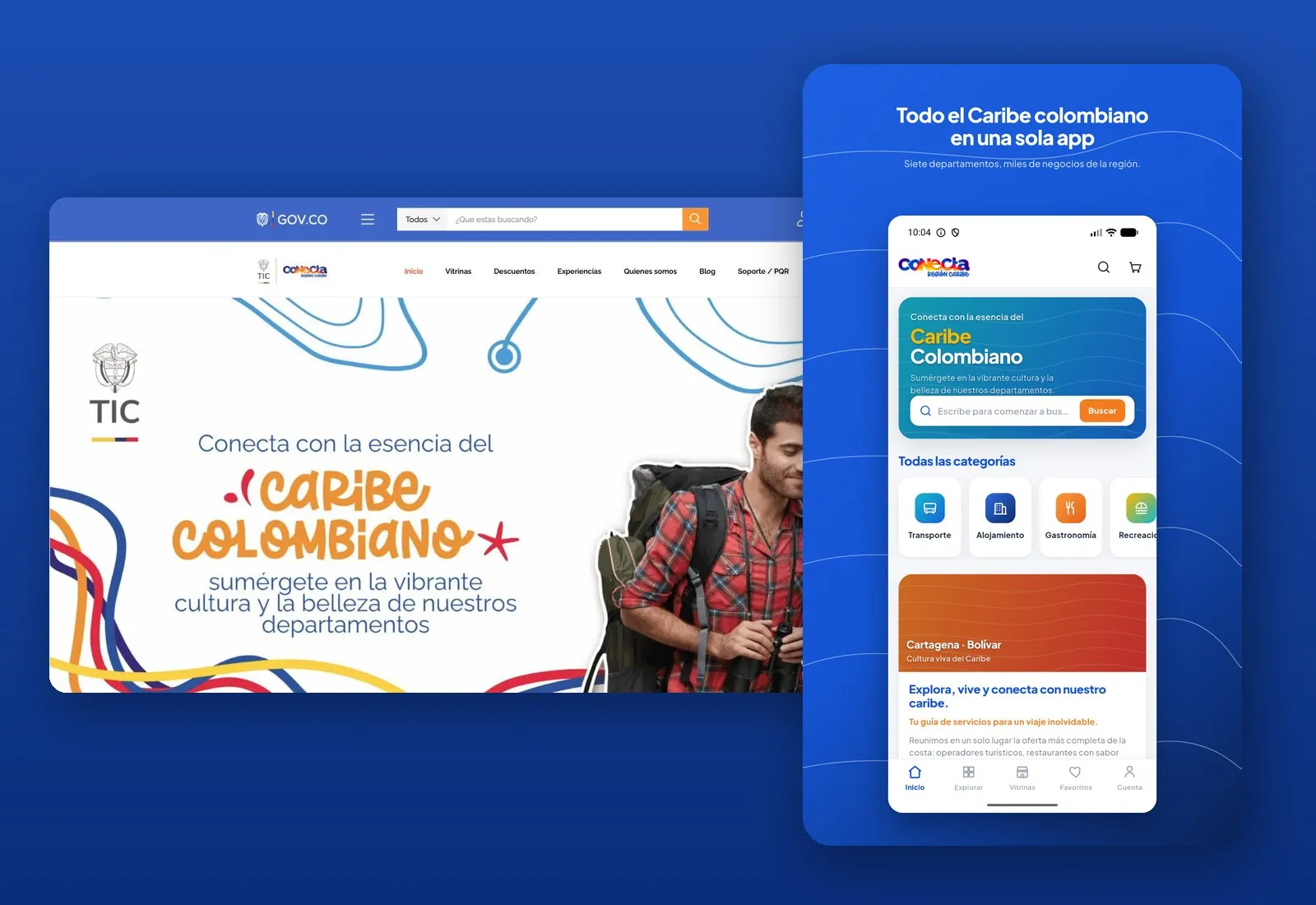
Many sellers, one catalog: seller sign-up and storefront, self-managed products, search with filters and, if the model calls for it, commissions and payouts. Conecta Región Caribe, which we built together with GreenTech Supply, is a platform of this kind: a storefront per business, self-managed catalog and search, with direct contact instead of commissions.

03

Dropshipping and supplier platforms

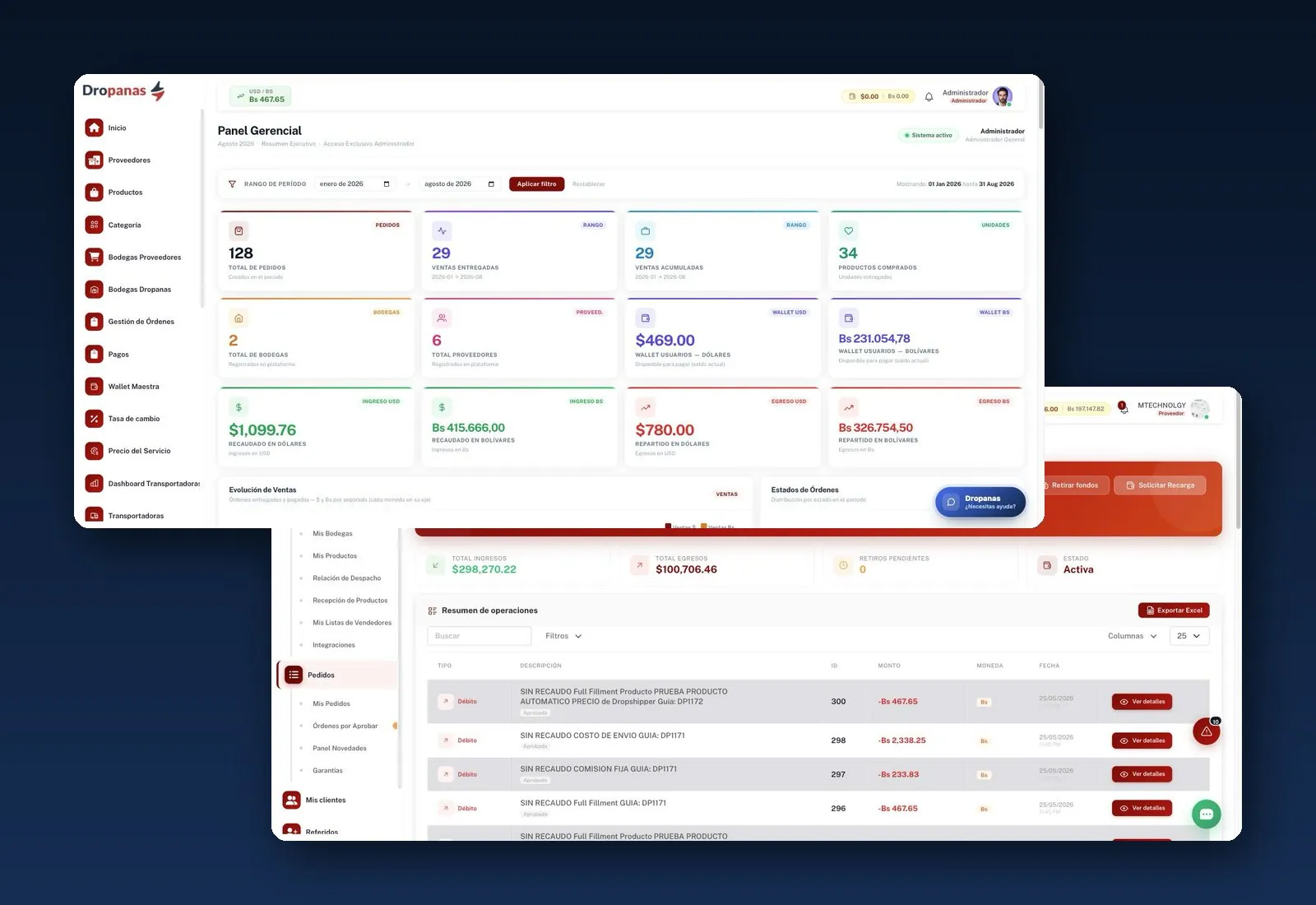
Suppliers who upload their products and variants, warehouses with traceable inventory, sellers who sell without touching the goods and a wallet that shows who each peso belongs to. It’s what we built for Dropanas.

04

Multichannel inventory and orders

A single inventory for the online store, physical locations and external channels, with each order’s status visible to whoever needs it: warehouse, shipping, customer service and the buyer.

05

A WhatsApp agent connected to the order, not a chatbot with canned replies

With Support 360, WhatsApp customer service with the order in view, WhatsApp inquiries and the other channels come into a single queue, and whoever replies —a person or an assistant— checks the order’s real status instead of guessing it. With WooCommerce the connection works both ways, and whatever the assistant can’t back up goes to a person.

Integrations

What systems does an ecommerce business integrate with in Colombia?

These are the integrations almost every Colombian ecommerce business ends up needing. The final list comes out of the assessment: first we look at what you already have in place, not at what we prefer. If your system isn’t listed here, that’s not a “no”: we review it before promising anything.

Payments

An approved payment updates the order status automatically and is ready to reconcile. Wompi and PayU are the ones we offer in our online stores; the others are common in Colombia and are reviewed in the assessment.

  • Wompi
  • PayU
  • ePayco
  • Mercado Pago
  • PSE, cards and Nequi
  • Cash and cash on delivery

Electronic invoicing

In Colombia, the store sale generates its electronic sales invoice, validated by the DIAN (the national tax authority) with its CUFE, without retyping it. It connects to the software or technology provider you already use.

  • World Office
  • Siigo
  • Alegra
  • Your invoicing provider

Accounting and inventory (ERP)

A single inventory and a single sales record, without copying from one system to another: that is integrating the store with your ERP.

  • Odoo
  • Your accounting software
  • Your ERP

Carriers

Quote shipping in the cart, create the shipping label from the order and notify the customer. These are the usual ones in Colombia; the connection depends on the method each one offers your account. If your operation is mostly shipping, see also technology for logistics companies.

  • Coordinadora
  • Servientrega
  • Envía
  • Interrapidísimo
  • TCC
  • Shipping aggregators

Messaging

Confirmations, order status and customer service with the order in view.

  • WhatsApp Business API

Store platforms

Keep the store that already works and connect what it’s missing.

  • WooCommerce
  • Shopify
  • Custom-built

We have no commercial partnership with any of these providers. The ones that don’t appear in our projects are named because they’re the usual ones in Colombia, and the connection with each one is confirmed in the assessment.

How we work

How do we run an ecommerce project?

  1. 01

    30-minute assessment, free of charge

    You tell us how an order comes in today and where it gets stuck. We come out with a map of what to connect and what to build, or with the recommendation not to build anything.

  2. 02

    Mapping with the people who do the work

    Warehouse, shipping, accounting and customer service: the right software comes from the real process, not from an org chart.

  3. 03

    Built in increments

    You test working progress, not a document at the end. Integrations are tested first in a sandbox environment, with dummy orders, before touching your live store.

  4. 04

    Migration and go-live

    We move your products, customers and history, verified with your team, and go-live is scheduled so you don’t lose sales.

  5. 05

    Support and evolution

    Ecommerce changes every season, and the system changes with it. If you need it, we also take care of hosting for WordPress and WooCommerce stores.

Real projects

What we’ve built for ecommerce

Dropshipping, a brand’s own store, a marketplace and quote-based sales: four different ways of selling online, each with its own operation behind it.

Dropanas

Dropshipping and logistics in two currencies

Redesign of the entire platform and what it was missing to run the operation in Venezuela: a wallet per user in dollars and bolívars, inventory by warehouse with traceability, the waybill whose status the seller, the warehouse, the courier and the carrier can see without calling to ask, the courier’s close by payment method, a supplier portal, a bridge to Shopify stores and an API with tokens, a sandbox environment and webhooks. Sixteen profiles, each with its own dashboard.

See the project: Dropanas
Tocco de Amore

A WooCommerce store with local payments

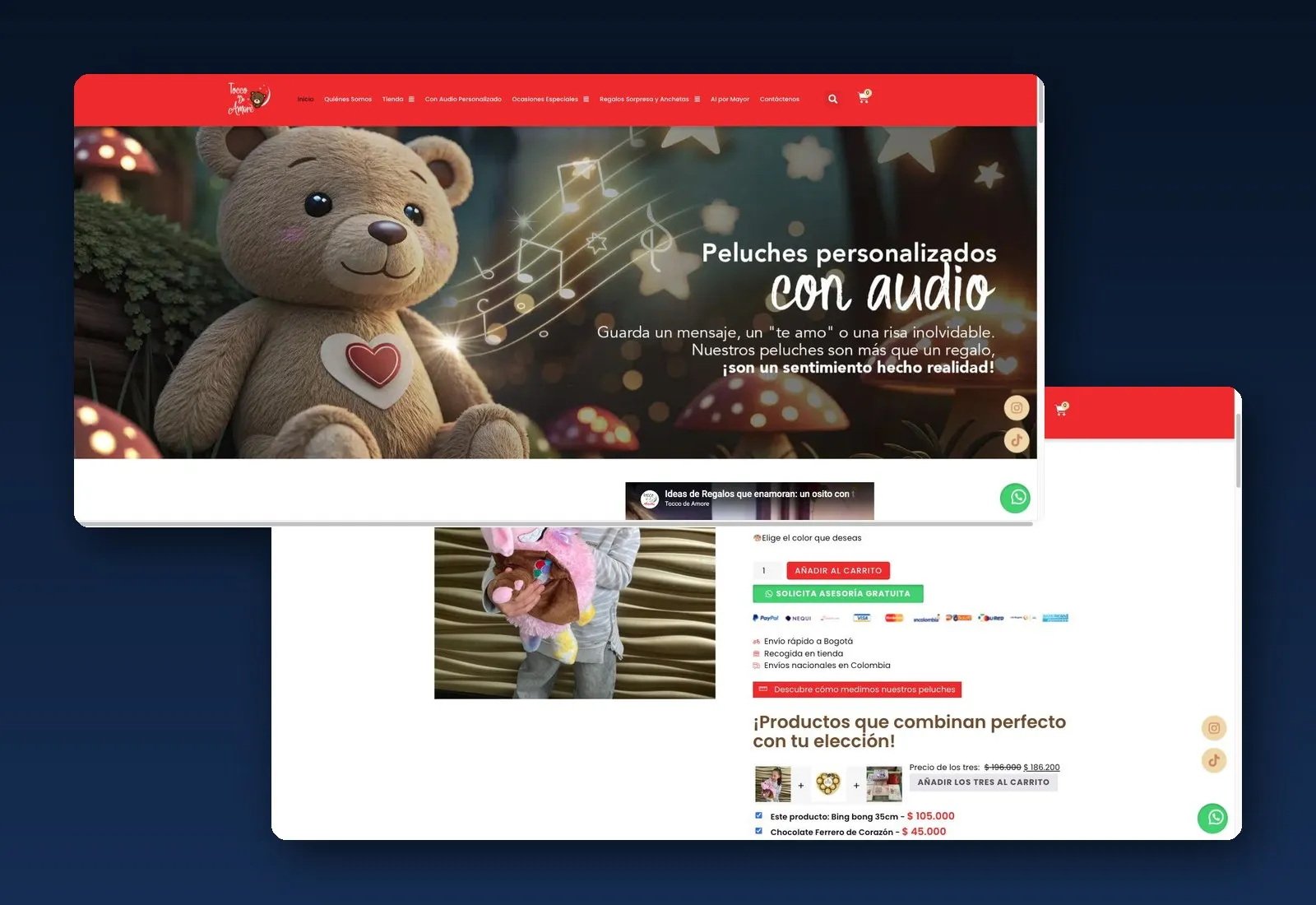
Redesign of the store for personalized plush toys with audio, in Bogotá: 271 products reorganized by occasion, price and category filters, product pages that answer payment, shipping and size questions before they come up, payments through PSE, Nequi, Bancolombia, Efecty, Baloto, Su Red and card, nationwide shipping with in-store pickup and WhatsApp assistance on every product.

See the project: Tocco de Amore
Conecta Región Caribe

A multi-vendor marketplace for the Caribbean region

With GreenTech Supply we built the web platform and the Android app for this project by Colombia’s Ministry of ICT (MinTIC) with the Universidad de Cartagena: a storefront per business that merchants fill in from their phone, search by department, city and category, a map of nearby stores and direct contact via WhatsApp. MinTIC reports more than 6,600 registered stores; that’s a program figure, not a measurement of ours.

See the project: Conecta Región Caribe
Tuenvase

Quote-based B2B sales

A digital catalog of plastic containers by product line, with a quote request right from each product page, designed so the client’s own team can keep it up to date. It’s ecommerce where the sale closes with a quote, not a shopping cart.

See the project: Tuenvase

The projects belong to their clients and MTechnology is who built them; each case study credits them. We don’t publish these clients’ sales figures because we haven’t measured them with them. See the full portfolio.

Frequently asked questions

Frequently asked questions about ecommerce software

Do you have to rebuild my store to integrate it with my other systems?

Not necessarily. If your store works and sells, the usual approach is to keep it and connect what it’s missing: payment gateway, accounting software, carriers or WhatsApp. We only propose rebuilding it if the platform doesn’t allow the integration or if maintaining it costs more than replacing it.

Can you connect my Shopify or WooCommerce store to Odoo, Siigo, Alegra or World Office?

We’ve already done it with Odoo in a real project. With the others, if the system has an API or a documented way to receive data, it can be connected. We confirm it in the assessment against your subscription plan, because not every plan of the same software unlocks the same features. Sometimes an extension already exists that solves it and, in that case, we recommend it.

What’s the difference between an online store and a marketplace?

In an online store, a single company sells its own catalog. In a marketplace, many independent sellers sell on the same platform, each with their own products, prices and shipping, and the platform charges a commission or a subscription. That’s why a marketplace needs what a store doesn’t: seller sign-up, payouts, commission rules and a catalog that stays organized without anyone curating it by hand.

How is the electronic invoice issued when the sale comes in through the store?

In Colombia, the electronic sales invoice is issued by your invoicing software or your technology provider, and validated by the DIAN, which assigns it a CUFE. What the integration does is send that software the paid order’s data —customer, products, taxes and shipping— so the invoice goes out without retyping. We don’t replace your invoicing provider: we connect it.

How much does it cost to integrate or develop my ecommerce platform?

It depends on how many systems need to be connected, whether they have an API and how much custom logic your operation has. After the free assessment we give you a phased scope in writing with its price, so you can start with the integration that’s costing you the most time.

Can a WhatsApp chatbot reply with the order’s real status?

Yes, if it’s connected to where the order lives. With Support 360, the assistant checks the store before replying —with WooCommerce, both ways— instead of repeating answers written in advance, and whatever it can’t back up goes to a person along with the full conversation. If your store is on another platform, we review in the assessment what can be connected.


Which part of your operation is still done by hand?

Let’s start there. Tell us how an order comes in today and where it gets stuck: in 30 minutes, free and with no commitment, we’ll tell you what to connect, what to build and what doesn’t need touching. You can also book your ecommerce assessment from the contact page.

This form is served by our CRM provider, so you need to accept functionality cookies.

Or message us on WhatsApp
Message us on WhatsApp
WhatsApp

Book a call

Choose a day (Bogotá time, UTC−5)
Time
Your details

Confirmation arrives by WhatsApp and email. Prefer to write directly? [email protected]